Home / Head-to-head
Bushnell Tour V7 Shift vs Nikon Coolshot Pro Stabilized
The Bushnell Tour V7 Shift and Nikon Coolshot Pro Stabilized are both 6x lasers in the ±1-yard class, trading off in opposite directions: the Bushnell is the tour-proven premium option (1,300-yard range, IPX6, physical Slope Switch); the Nikon is the mid-range stabilised pick (180 g, anti-shake stabilisation, tighter ±0.75-yard reads).
Both rangefinders sit in the same precision class — 6x magnification and readings that land within roughly a yard — which is exactly why they're worth comparing directly. The decision between them is not which one measures more accurately: at this level, both give you a number you can choose a club on. It's how each one gets you that number, what it costs, and which small problems each one solves on the course.
The Bushnell Tour V7 Shift is the pure, tour-proven laser: point, shoot, get your yardage within ±1 yard, out to a maximum of 1,300 yards. It runs on a CR2 battery that lasts roughly a season, shrugs off rain at IPX6, and carries a physical Slope Switch that disables slope-compensated distances with one click — the cleanest competition setup in this pair, because there are no menus and no modes to forget: a switch that opponents can see and verify. At 255 g it's the heavier unit, and it sits in the premium price band, but it's the rangefinder more tour players carry than any other, and the premium pays for that pedigree, the extra range and the stronger water resistance.
The Nikon Coolshot Pro II Stabilized attacks a different problem: hand shake. A 6x lens magnifies every tremor sixfold, and an unsteady pulse — coffee, fatigue, cold, adrenaline — turns locking the flag into a three-or-four-attempt fight. Nikon's STABILIZED technology reduces viewfinder vibration to roughly a fifth, and crucially it steadies the laser itself, not just the picture, so you get a clean lock faster and on the first try. It's also 75 g lighter (180 g), reads marginally tighter than the Bushnell (±0.75 yd under 700 yd), covers 8 to 1,200 yards — still beyond the longest par 5 — and handles slope tournament-legal too: its ID Technology mode shows an Actual Distance Indicator that blinks green when slope compensation is off, visible to anyone watching. All of that at a mid-range price and with the same CR2 battery.
The honest arithmetic: both give you the number you need on every approach shot, both are legal in competition with slope off, and neither is the wrong buy for every player. The Bushnell's premium pays for tour-proven simplicity, 100 extra yards of maximum range, stronger water resistance and the most foolproof tournament switch in the category. The Nikon pays for stabilisation — which saves you the frustration of re-shooting the same pin three times when your hands aren't steady — plus a unit light enough to disappear into a pocket, marginally tighter readings and a lower price. If your hands are steady and you compete, the Bushnell is the safest spend; if your hands shake, or you'd rather not pay for tour pedigree you don't need, the Nikon does the same core job for less.
Both are verified against the manufacturers' own spec sheets: Bushnell's published figures (5–1,300 yd, ±1 yd, 6x, IPX6, Slope Switch) and Nikon's official COOLSHOT PROII STABILIZED page (8–1,200 yd, ±0.75 yd under 700 yd, 6x, 180 g, CR2, STABILIZED and LOCKED ON technologies). Those are the numbers this comparison is built on — we don't publish figures we haven't traced to the brand's own page.
| Bushnell Tour V7 Shift | Nikon Coolshot Pro II Stabilized | |
|---|---|---|
| weight | 0.255 kg | 0.18 kg |
| dividers | — | — |
| pockets | — | — |
| € | premium | mid-range |
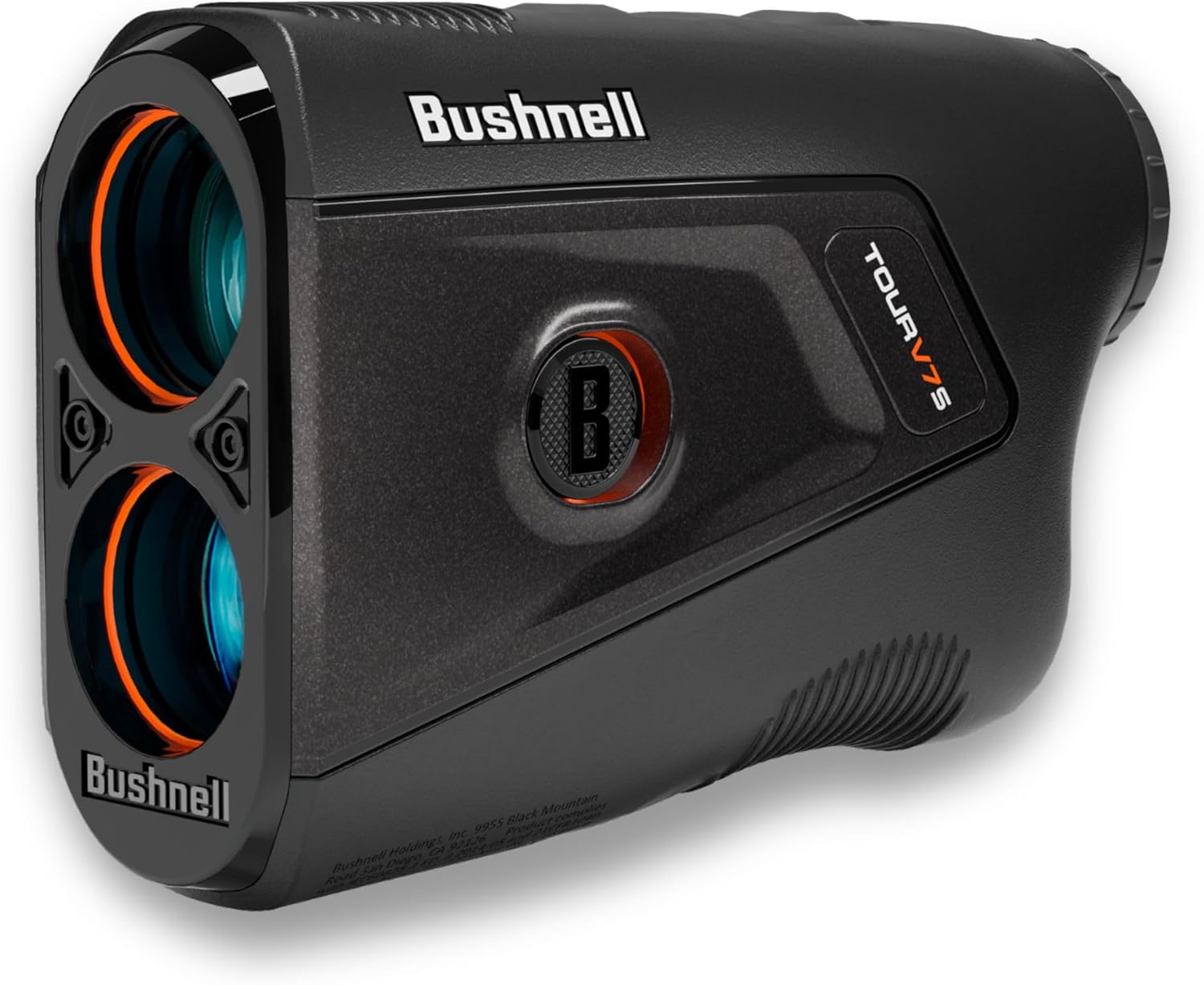
Bushnell Tour V7 Shift
- weight
- 0.255 kg
- material
- Plastic (polycarbonate housing)
rangefinderpremium

Nikon Coolshot Pro II Stabilized
- weight
- 0.18 kg
- material
- Plastic (rubber coating)
rangefindermid-range
Choose the Bushnell Tour V7 Shift if you want the tour-proven standard: the physical Slope Switch, the 1,300-yard maximum range and IPX6 water resistance are what the premium price pays for, and it's the most foolproof competition option of the two. Choose the Nikon Coolshot Pro Stabilized if hand shake costs you re-shots, you want the lighter unit (180 g), or you'd rather stay in the mid-range: it reads to ±0.75 yards under 700, reaches 1,200 yards, and its slope mode shows an external indicator when it's off, so it's just as competition-legal.
Price links coming soon — we're setting up Amazon Associates for this store.
FAQ
Is the Nikon's image stabilisation worth it over a plain laser?
If your hands are steady, no — a standard ±1-yard laser locks the flag the same way. If they aren't (coffee, fatigue, cold, adrenaline), stabilisation is the difference between one clean reading and three or four attempts at the same pin, and Nikon's system steadies the laser itself, not just the viewfinder picture. It's a comfort feature that, for many players, decides whether the rangefinder gets used on every shot or left in the bag.
Which of the two is more accurate?
On paper the Nikon: ±0.75 yd under 700 yd against the Bushnell's ±1 yd. In practice both are far inside the margin that changes a club choice — a yard either way doesn't turn a 7-iron into a 6-iron. Accuracy stops being a meaningful differentiator at this level; what separates these two is stabilisation, weight, range and price.
Can I use either rangefinder in competition?
Yes, with slope off. The Bushnell has a physical Slope Switch — one click and compensated distances are off, visible and verifiable. The Nikon uses ID Technology with an Actual Distance Indicator that blinks green when slope compensation is not in use, so other players can see it's in legal mode. Both conform to the R&A/USGA rules that allow distance-measuring devices in competition.
Does the Bushnell's 1,300-yard range matter compared with the Nikon's 1,200?
Not for approach shots — the longest par 5 rarely exceeds 600 yards, so both cover every shot you'll play with room to spare. The extra 100 yards only shows up when ranging a distant tee box or a practice-range flag, where the Bushnell locks on a little more readily.
Why is the Bushnell more expensive if the Nikon reads tighter and weighs less?
The premium price covers tour pedigree ('#1 rangefinder on tour'), a longer maximum range, IPX6 against the Nikon's IPX4, and the physical Slope Switch — the most foolproof tournament toggle in the category. The Nikon concentrates its cost in the stabilisation module, which is why it weighs less and costs less while still reading tightly. Either way you're not paying for raw accuracy: both are already inside the margin you need.
Guides
Best golf rangefinder: laser, GPS or bothIs a rangefinder legal in tournament play? Rule 4.3a(1) explained
More head-to-heads
Callaway X-Series Stand Bag 2024 vs OGIO Fuse Stand BagCallaway Supersoft vs Titleist Pro V1Callaway Supersoft vs TaylorMade Distance+Bushnell Tour V7 Shift vs Garmin Approach Z82
Try the bag finder →Try the ball finder →Bag & gear glossary →