Home / Head-to-head
Nikon Coolshot Pro II Stabilized vs Garmin Approach Z82
Both are 6x lasers with image stabilisation, so either will give you a number you can pick a club on. The split is what else you want: the Nikon Coolshot Pro II Stabilized is a 180 g pure laser in the mid-range band; the Garmin Approach Z82 adds GPS course maps inside the viewfinder at premium money.
These two sit in the same precision class, and neither is a compromise on the core job: both magnify 6x, both steady the image so an unsteady pulse doesn't turn locking the flag into a fight, and both read far more precisely than a club choice needs. That is exactly why the comparison is worth making properly — the decision is not which one can measure a flag, it is what each one does with the rest of the money.
The Nikon Coolshot Pro II Stabilized is the mid-range pure laser of the pair: 180 g excluding the battery, the lightest rangefinder in our catalogue, running on a single CR2 you can swap in seconds. Nikon quotes a measurement range of 7.5-1,090 m / 8-1,200 yd, with accuracy of ±0.75 m/yd below 700 and ±1.25 m/yd between 700 and 1,000, through a 6x monocular with a 21 mm effective objective diameter, a 7.5° field of view and 18 mm of eye relief — enough for glasses. Its STABILIZED system, in Nikon's own wording, reduces viewfinder vibration caused by hand movement to a fifth or less and aligns the irradiated laser at the same time, so the reading lands on the first press instead of the fourth. LOCKED ON adds first-target priority with a green sign and an audible confirmation when the distance displayed is the flagstick and not the trees behind it. For competition, ID Technology uses an Actual Distance Indicator that blinks green whenever slope compensation is not in use, so playing partners can see the unit is in legal mode without having to ask. HYPER READ returns a result in roughly 0.3 s, and the body is waterproof and fogproof across -10 to +50 °C.
The Garmin Approach Z82 is the premium option, and the one that changes what you are looking at. Its laser is accurate to within 10 inches (25 cm) of the pin and ranges up to 450 yards, per Garmin's own launch specification, and it carries image stabilisation plus vibrational feedback on lock. What you are really paying for is the second layer: full-colour 2-D CourseView maps overlaid in the viewfinder, with front, centre and back green distances, Green View on the putting surface and hazard and layup figures — Garmin quoted over 41,000 courses worldwide when it launched the model. When the laser locks the flag, the map zooms to the green and draws a Laser Ranged Arc at the exact distance you ranged, so you see the shot and not just the number. The OLED display keeps better eye relief for glasses wearers, the spec sheet lists IPX7 (incidental immersion at up to 1 m for 30 minutes) and up to 15 hours of typical use from an internal rechargeable battery, and Tournament Mode is confirmed by a solid blue LED on top of the device rather than a setting only you can see. At 232 g and about 12.2 × 8.0 × 4.2 cm it is the heavier and bulkier of the two — and its laser reaches a fraction of the Nikon's range.
Lay the two side by side and the honest arithmetic is that accuracy is not the reason to spend more. The Z82's ±10 inches (25 cm) reads finer than the Nikon's ±0.75 yd inside 700 yd, but a fraction of a yard does not turn a 7-iron into a 6-iron — both are well inside the margin that changes a club. The premium buys context instead: front, centre and back plus hazard numbers inside the same viewfinder, which a pure laser cannot give you at any price and which matters most on a course you do not know. It also buys a bigger, heavier unit, a rechargeable battery that needs a cable, and a laser that stops at 450 yards — enough for every flag you will shoot, not enough to range a distant tee box or a practice-range flag, which the Nikon's 1,200-yard range handles easily. The Nikon, in exchange, is 52 g lighter, runs on a battery you can carry a spare of, and publishes no IP rating: Nikon states waterproof and fogproof, which is a less specific claim than Garmin's IPX7.
So the split comes down to the courses you play and the pocket you have. If you play the same home course every week and want a light, stabilised, visibly competition-legal laser that never needs charging, the Nikon does everything a rangefinder needs to do for a band less. If you play unfamiliar courses, want to see the shape of the green and the position of the hazards without pulling out a phone or a watch, and are happy to charge it alongside your other devices, the Z82 is a different tool rather than a more expensive version of the same one.
| Nikon Coolshot Pro II Stabilized | Garmin Approach Z82 | |
|---|---|---|
| weight | 0.18 kg | 0.232 kg |
| dividers | — | — |
| pockets | — | — |
| € | mid-range | premium |

Nikon Coolshot Pro II Stabilized
- weight
- 0.18 kg
- material
- Plastic (rubber coating)
rangefindermid-range
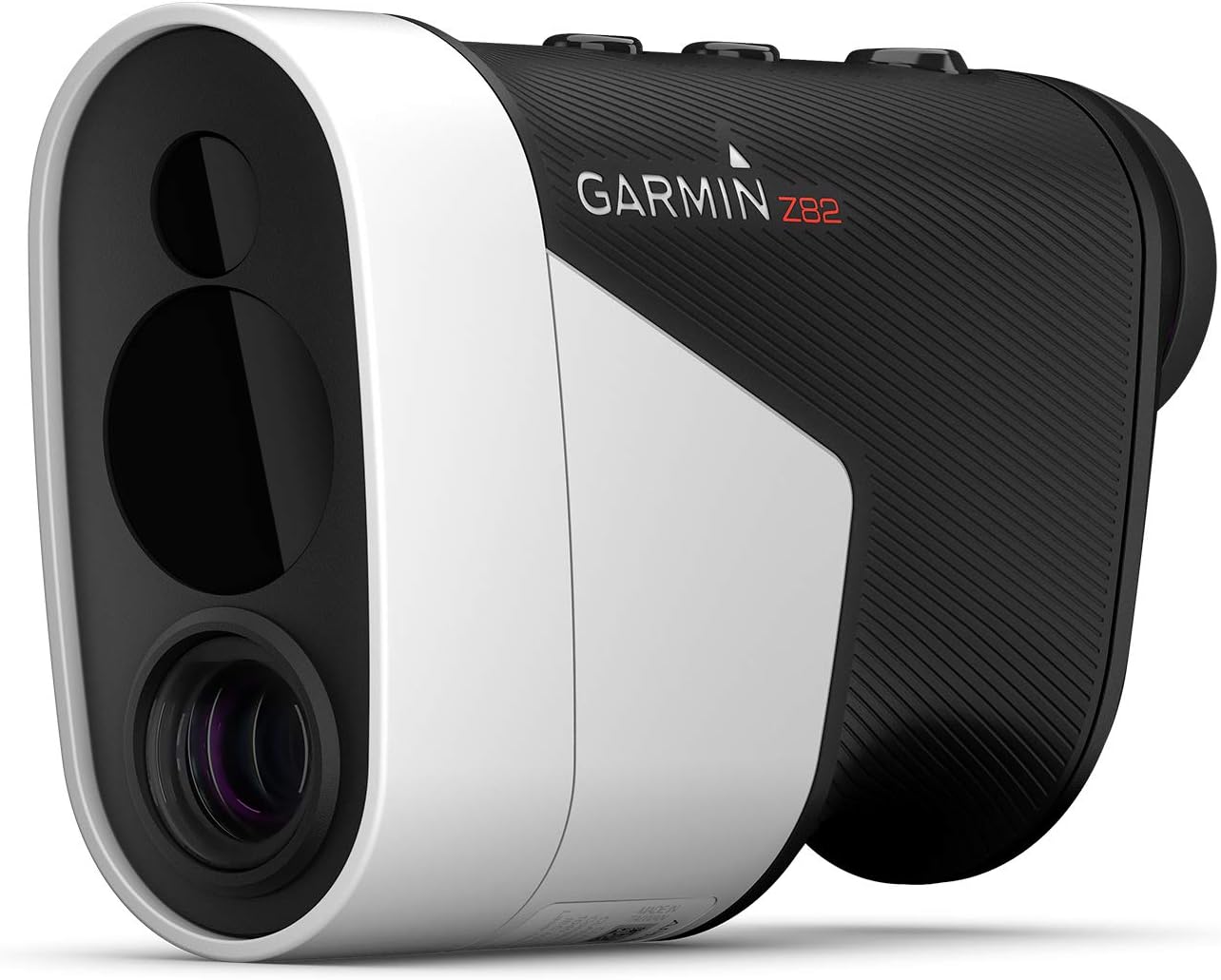
Garmin Approach Z82
- weight
- 0.232 kg
- material
- Plastic (polycarbonate, rubberized grip)
rangefinderpremium
Choose the Nikon Coolshot Pro II Stabilized if you want a light (180 g), stabilised, mid-range laser for the course you already know: ±0.75 yd inside 700 yd, 8-1,200 yd of range, a CR2 you can replace in seconds and an Actual Distance Indicator that shows playing partners the slope is off. Choose the Garmin Approach Z82 if you play different courses and want the GPS layer inside the viewfinder — CourseView maps, front/centre/back green distances and hazard figures with a Laser Ranged Arc — and you accept 52 g more, a rechargeable battery and a 450-yard laser in exchange for it.
Price links coming soon — we're setting up Amazon Associates for this store.
FAQ
Do both of these actually have image stabilisation?
Yes. Nikon states that its STABILIZED system reduces viewfinder vibration caused by hand movement to a fifth or less and aligns the laser at the same time, so the measurement lands where the picture is pointing. Garmin lists image stabilisation together with vibrational feedback on lock in its own launch materials for the Z82. If hand shake is what has been costing you re-shots at the flag, neither of these is a compromise — the stabilisation is the feature they share.
Which one is more accurate?
On paper the Garmin: it is specified to within 10 inches (25 cm) of the pin, against the Nikon's ±0.75 m/yd inside 700 yd. In practice both are far inside the margin that changes a club choice — the difference between 150 and 151 yards does not alter your shot. Precision stops being a useful differentiator at this level; what separates these two is the GPS layer, the weight and the price band.
Can I use either one in competition?
Yes, with slope compensation switched off. On the Nikon, ID Technology's Actual Distance Indicator blinks green whenever the incline/decline function is not in use, so other players can see the unit is in legal mode. On the Garmin, enabling Tournament Mode lights a solid blue LED on top of the device, which is just as visible to the group. Both are distance-measuring devices of the type allowed under the R&A and USGA rules that permit them, as long as the slope-adjusted reading is disabled.
Is the Garmin's 450-yard laser a real limitation?
Not for flags. Approaches are played between roughly 50 and 200 yards and even the longest par 5 rarely runs past 600 yards, so 450 yards covers every pin you will ever shoot at. Where it does limit you is ranging something far away — a distant tee box, a practice-range flag or a landmark — which the Nikon's 1,200-yard range does easily. If you never range anything but the pin, you will not miss the extra range.
Which one is easier to live with over a season?
They trade off. The Garmin runs up to 15 hours of typical use on an internal rechargeable battery, so it needs a cable and a routine; forget to charge it and you play the round without it. The Nikon runs on a single CR2 that lasts roughly a season of normal use and can be replaced in seconds, and it weighs 52 g less in the pocket or on the bag strap. If you already charge a phone and a watch, the rechargeable battery is one less consumable; if you would rather not depend on a charger, the CR2 is the more forgiving design.
Guides
Best golf rangefinder: laser, GPS or both
More head-to-heads
Callaway X-Series Stand Bag 2024 vs OGIO Fuse Stand BagCallaway Supersoft vs Titleist Pro V1Callaway Supersoft vs TaylorMade Distance+Bushnell Tour V7 Shift vs Garmin Approach Z82
Try the bag finder →Try the ball finder →Bag & gear glossary →